
 Upload Script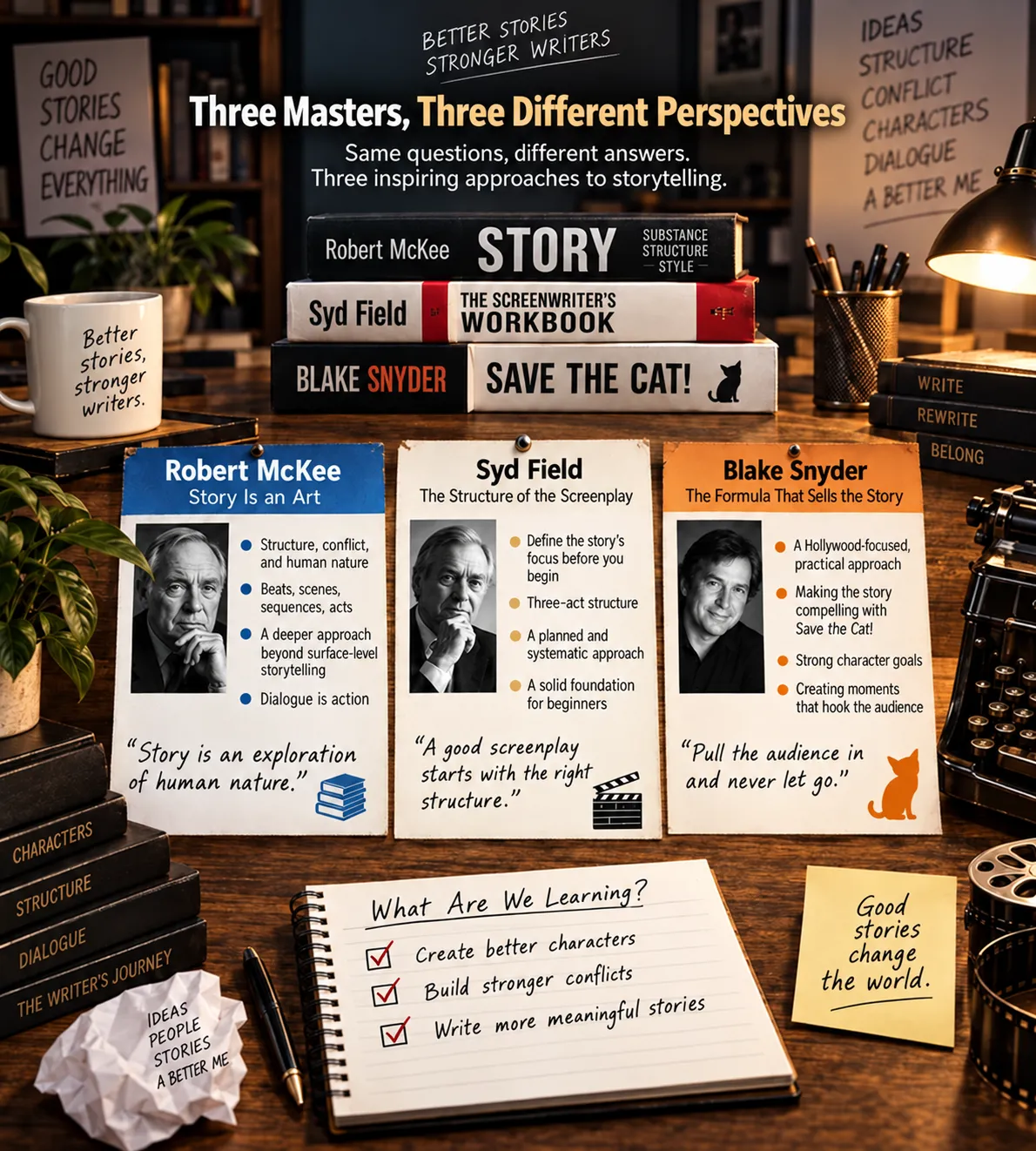
Reading all six books at once didn’t just give me information. It gave me total whiplash.
My first week of studying screenwriting was basically an orientation week with three completely different teachers: Robert McKee, Syd Field and Blake Snyder. Each of them approaches screenwriting from a completely different angle, and switching between their books constantly felt like three people fighting for control of my brain.
McKee sounded like a prestigious university professor. Field approached screenwriting like an architect holding a calculator. Snyder sounded like a Hollywood agent trying to sell me a movie.
By the end of the week, my working memory was completely maxed out.
But the biggest thing I realized was that these three screenwriting authors are actually talking about many of the same fundamental problems from completely different perspectives.
Robert McKee: Story as Craft, Conflict and Human Nature
Right out of the gate, I have to say McKee is by far my favorite.
I’m the kind of person who believes cinema is an art form. It should be about people, psychology and the messiness of human nature. That is probably why Robert McKee’s approach immediately connected with me.
In Story, McKee treats screenwriting as a craft built around structure and conflict. He breaks a story down into smaller structural units: beats, scenes, sequences and acts.
The story builds from the bottom up.
A beat is essentially an exchange or change between characters. Those beats build into scenes, and McKee argues that a meaningful scene should end with a value change in a character’s life condition. Several scenes then form a sequence, while sequences accumulate into acts.
That way of thinking made screenwriting feel less like simply writing dialogue and more like constructing a chain of meaningful changes.
McKee is also highly critical of what he sees as shallow storytelling. His approach emphasizes understanding human nature and dramatic substance rather than relying on spectacle or cheap tricks.
For him, Story is not simply a formula for writing a screenplay. It is an argument that screenwriting requires craft, knowledge and a deep understanding of structure.
What McKee Says About Screenwriting Dialogue
In Dialogue, McKee takes this idea even further by breaking dialogue into three layers:
- Text: What the character literally says.
- Subtext: What the character actually means underneath the words.
- Deep psychological truth: The underlying psychological force driving the conversation.
This completely changes the way dialogue can be viewed.
Talking isn’t just filler between important moments. Dialogue is action.
A character speaks because they want something. They are trying to achieve something through the conversation, and that desire creates conflict.
If dialogue doesn’t push a scene toward action or reveal something important about the conflict, McKee’s approach makes it difficult to justify its existence.
That is what I liked about his writing. He treats screenwriting with actual respect. He wants the script to have a soul and to say something meaningful.
Syd Field: The Structure Behind the Screenplay
If McKee teaches me how to think about story as an art, Syd Field feels much more like an engineer.
In The Screenwriter’s Workbook and The Screenwriter’s Problem Solver, Field encourages writers to define the focus of their screenplay before they start writing.
What is the story actually about?
What does the character want?
What is the character’s dramatic need?
For a beginner, this is useful because defining these elements can provide a starting point when facing the blank page.
Field’s approach is heavily focused on structure. His famous three-act paradigm divides a screenplay into three major sections:
- Act One – Setup: Approximately pages 1–30.
- Act Two – Confrontation: Approximately pages 30–90.
- Act Three – Resolution: Approximately the final 30 pages.
His Workbook and Problem Solver expand on the practical problems writers can encounter while developing a screenplay.
My Problem With Syd Field
This is where I struggled.
His first chapter was incredibly boring to me. He spends a lot of time talking about himself and his own history, with a level of repetition that genuinely made me wonder whether the pages had a misprint.
And when he finally got into the screenwriting advice, I found myself confused.
His examples felt incredibly specific from a beginner’s perspective. Instead of gradually introducing the concepts, I felt like I was being thrown into the deep end of screenplay formatting and structure before I even knew exactly what I wanted to write.
Still, I can see why Field’s approach is useful.
His books give a writer something that can be extremely valuable at the beginning of the process: a skeleton.
Blake Snyder: What Is Your Movie About?
Then there is Blake Snyder.
Snyder takes a completely different approach.
Instead of immediately diving into the mechanics of writing scenes, he asks a much more commercial question:
What is your movie about?
And more importantly, can you pitch it in one sentence?
That sentence is the logline.
In Save the Cat!, Snyder emphasizes the importance of creating a movie concept that can immediately communicate its appeal. He argues that a strong pitch needs elements such as irony, a clear mental picture and a title that matches the concept.
Compared with McKee and Field, Snyder feels much more casual and commercial.
McKee is interested in human nature and artistic substance.
Field is interested in structure and problem-solving.
Snyder is interested in whether someone would actually want to buy a ticket.
And honestly, this is where I had the biggest problem with him.
Why I Struggled With Blake Snyder
Snyder represents almost everything I dislike about the commercial side of the film industry.
His approach feels aggressively commercial to me, and I struggled with the idea of reducing storytelling to something that can be communicated through a marketable concept, poster or pitch.
I already have a complicated relationship with the assembly-line approach to modern cinema, so reading Snyder sometimes felt like reading the diary of a corporate sellout.
But even though I disliked parts of his philosophy, I have to admit that his approach taught me something useful.
A great story still needs to communicate its core idea.
If you cannot explain what your movie is about, you may have a problem before the screenplay even begins.
McKee vs. Syd Field vs. Blake Snyder
After reading all six books simultaneously, I started to understand that these writers are not necessarily answering the exact same question.
They are approaching screenwriting from different directions.
| Screenwriting Author | Main Focus | What I Took From Them |
| Robert McKee | Story, conflict, character and meaning | How to write the story |
| Syd Field | Structure, dramatic need and screenplay development | How to structure and troubleshoot the story |
| Blake Snyder | Concept, logline and commercial appeal | How to pitch the story |
That distinction became the biggest lesson of my first week.
Field tells you how to think about the structure. McKee tells you how to write the story. Snyder tells you how to pitch it.
They may disagree about plenty of things, but all three are trying to solve different parts of the same larger problem:
How do you turn an idea into a screenplay that works?
What Reading All Six Books at Once Did to My Brain
So what actually happened to my brain after reading all six books at the same time?
It was basically a screaming match.
McKee made me want to watch a deep, character-driven masterpiece.
Then I would open Field and find myself bored out of my mind by the autobiography before trying to understand his structural examples.
Then I would open Snyder and rage at the idea that art could be reduced to a corporate checklist.
And yet, I loved the contrast.
Reading them simultaneously forced me to see that there isn't necessarily one universal way to think about screenwriting.
Each author made me question the others.
McKee made me think about why a story matters.
Field made me think about how a story is constructed.
Snyder made me think about how a story is communicated and sold.
That tension was probably more useful than simply reading one book and accepting its philosophy without comparison.
First Week Verdict: Robert McKee Is My Favorite
After the first week, Robert McKee is my clear favorite.
His approach is the closest to how I personally think about cinema: as an art form built around people, conflict, psychology and human nature.
But even though McKee was my favorite, I can't say the other books were useless.
Field gave me a structural framework.
Snyder forced me to think about the concept and pitch.
McKee made me think about the soul of the story.
And perhaps that is the real value of reading them together.
They are not three identical screenwriting manuals.
They are three different ways of looking at the same creative problem.
Field gives you the structure. McKee gives you the story. Snyder gives you the pitch.
For my first week, that was more than enough brain melting.
And yes, Robert McKee wins.
I mean, Blake, we are trying to make art here.
Frequently Asked Questions
What is the difference between Robert McKee, Syd Field and Blake Snyder?
Robert McKee focuses heavily on story, conflict, character and the craft of screenwriting. Syd Field emphasizes screenplay structure, the three-act paradigm and dramatic need. Blake Snyder focuses more strongly on movie concepts, loglines and the commercial presentation of a story.
What does Robert McKee teach in Story?
McKee's Story presents screenwriting as a craft built around structure, conflict and meaningful changes in a character's life. He discusses structural units including beats, scenes, sequences and acts.
What does Syd Field's three-act structure mean?
Syd Field's paradigm divides a screenplay into three broad sections: setup, confrontation and resolution. In the framework described in the book, Act One occupies roughly the first 30 pages, Act Two the middle section, and Act Three the final portion of the screenplay.
What is a logline according to Blake Snyder?
A logline is a concise, one-sentence description of a movie's central concept. Snyder emphasizes the importance of making the concept immediately understandable and compelling as a movie idea.
Why is dialogue important in Robert McKee's approach?
McKee treats dialogue as more than simple conversation. He examines text, subtext and deeper psychological meaning, while emphasizing that characters use dialogue to pursue objectives and create conflict.
Which screenwriting book should a beginner read first?
The three authors approach screenwriting differently, so the most useful starting point depends on what a writer is trying to understand. McKee focuses on story and craft, Field on structure and screenplay development, while Snyder focuses on concept and pitching.
What can you learn by reading McKee, Field and Snyder together?
Reading the three approaches together can reveal how different aspects of screenwriting connect. McKee emphasizes the story itself, Field provides a structural framework, and Snyder focuses on communicating and pitching the concept.
Are McKee, Syd Field and Blake Snyder teaching the same screenwriting method?
No. Their approaches overlap in their interest in story and screenplay construction, but they emphasize different elements. McKee focuses on story craft and conflict, Field on structure and dramatic development, and Snyder on concept and commercial presentation.